

Orbital Atherectomy is an advanced catheter-based technique used to modify heavily calcified coronary artery blockages. Severe calcium deposits can make coronary arteries rigid and difficult to treat with conventional angioplasty. This advanced technique helps prepare appropriately selected calcified lesions for balloon angioplasty and stent placement.
Advanced evaluation and treatment planning for complex and heavily calcified coronary artery disease using modern interventional cardiology techniques and precision-guided treatment.
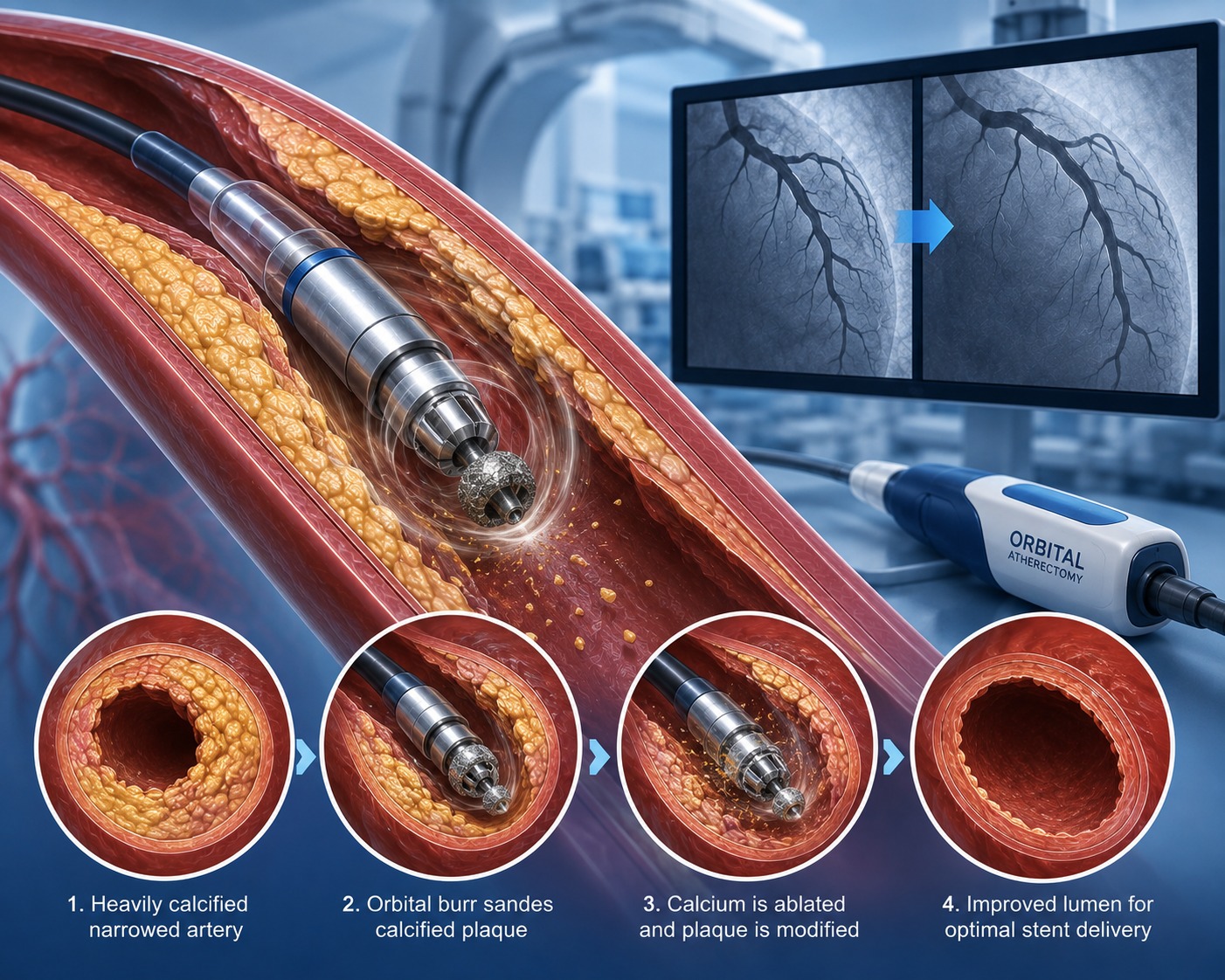

Orbital Atherectomy is an advanced catheter-based technique used during coronary intervention to modify heavily calcified plaque inside the coronary arteries. Severe calcium deposits can make the artery hard and rigid, making it difficult for balloons and stents to expand properly.
The procedure helps prepare appropriately selected calcified coronary lesions by modifying the calcium and improving vessel compliance before angioplasty and stent placement. It is performed in a cardiac catheterisation laboratory by an experienced interventional cardiologist.
Severe calcium deposits can make coronary arteries rigid and difficult to treat with conventional balloon angioplasty and stent placement.
Heavy calcium deposits can make coronary arteries hard and less flexible.
Calcified lesions may prevent balloons and stents from expanding adequately.
Severely calcified coronary blockages may require advanced lesion preparation techniques.
Careful assessment helps determine the most appropriate treatment strategy.
Orbital Atherectomy is performed as part of a carefully planned coronary intervention. The objective is to modify heavily calcified plaque and prepare selected coronary lesions for further treatment.
Orbital Atherectomy is not required for every coronary blockage. It may be considered for appropriately selected patients with severely calcified and complex coronary artery disease.
Patients with heavily calcified coronary artery blockages requiring advanced lesion preparation.
Coronary lesions that may not expand adequately with conventional balloon treatment.
Selected complex coronary procedures requiring careful treatment planning.
Not every calcified coronary blockage requires the same treatment. Advanced technologies may be used according to the patient's coronary anatomy and clinical condition.
Advanced imaging helps evaluate coronary anatomy and lesion characteristics.
In selected cases, intravascular imaging may assist treatment planning and stent optimisation.
Physiological assessment may help determine the significance of selected coronary blockages.
Advanced techniques may be selected for heavily calcified coronary lesions.
In appropriately selected patients, advanced calcium modification techniques may help prepare heavily calcified coronary lesions for subsequent intervention.
Advanced coronary imaging may assist in evaluating calcified lesions and planning precision-guided intervention in selected patients.
Helps evaluate the location and characteristics of coronary calcium.
Provides additional information regarding vessel size and lesion characteristics.
May assist in evaluating treatment results and appropriate stent optimisation.
Advanced technology should always be combined with careful clinical judgement and individualised treatment planning.
Careful assessment of the patient's symptoms, coronary anatomy and clinical condition.
Selecting the most appropriate treatment strategy according to individual patient needs.
Clear communication and shared decision-making with patients and their families.
Shripad Heart Centre provides expert evaluation for complex and heavily calcified coronary artery disease. Dr. Shripad V. Khairnar offers advanced treatment planning using modern interventional cardiology techniques and precision-guided approaches for appropriately selected patients.